• 2237 Chapter 1

    2237 Chapter 1

    “Although awakening is sudden, the cultivation that follows is gradual.”
    – Bojo Jinul, Secrets on Cultivating the Mind

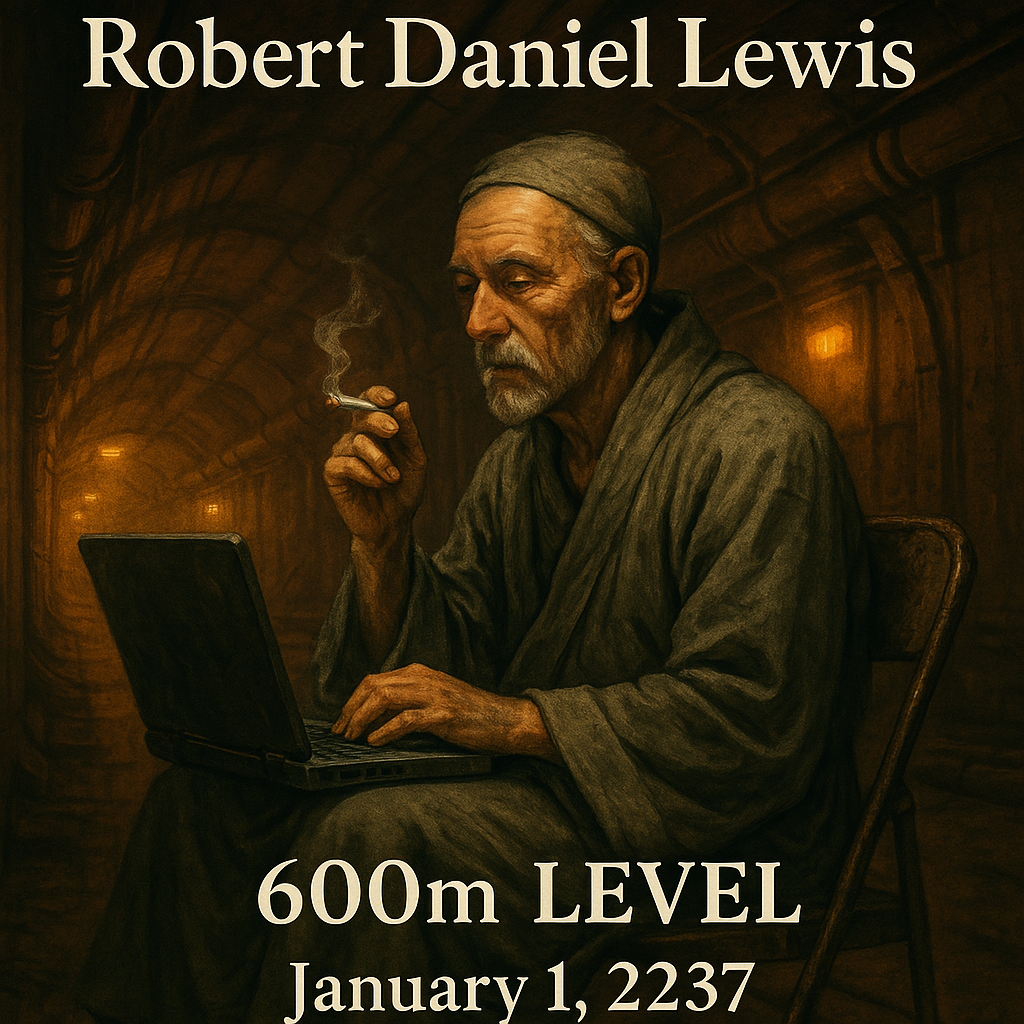
    It is 4am on Sunday, January 1st, 2237 as I sit wearing the old grey robes issued to me as a Buddhist monk of the Korean tradition while smoking my stale hand-rolled cigarette. Tobacco products are illegal in almost every jurisdiction now, but the smoke helps me think more clearly after a late night of drinking Appalachian moonshine. My doctor tells me I should quit, but at nearly 200 years old with no signs of slowing down, I figure I deserve a smoke or two. It isn’t like the nanobots flowing through my bloodstream will allow any cancer to grow. I couldn’t die if I wanted to with all the fancy medical tech they monitor and correct us with.

             New Year’s celebrations just aren’t the same at the 600m level in the subterranean depths beneath Mingo Junction Arcology. The tunnels get narrower and more cramped the deeper you go and my level is about as hot and humid as people can tolerate without serious air conditioning. These are truly undesirable apartments, far from the hustle of the hyperloop stations. We’re near enough to the geothermal plant at this depth that I can feel the hum of the generators kick up as early morning activity increase services demand.

    My name is Robert Daniel Lewis, but people call me Bob for short. I’m leaving this memoir so the people of future generations can know what it was like for us ordinary folk living in the post-American Appalachian territories right before the Global Authority puts the final nail in the coffin of nationalism and fully ushers in the world’s first truly one world government. Their unification of the world seems inevitable at this point. They’ve crushed the last holdouts of the Islamic resistance and only Israel remains as the final independent nation on Earth.

    Maybe no one will ever read this, but at least writing helps me organize my thoughts. The rusty old folding chair I’m sitting in hurts my hips, but I won’t be here for long. My New Year’s resolution is to type out 2,000 or so words a week, every week for the next year in order to organize and document my thoughts. I’m typing this on an old laptop computer. Typesetting is easier on this old school device so things print appropriately for physical pamphlets and short essays.

             Dictating into a virtual environment would be faster, but I never can get those documents to print the way I want them to on my old inkjet printer. I know how to use this software so I can get my margins, font size and headers and footers exactly like I want them, and I’m used to working on it because I print pamphlets for public distribution in my work as a lay Buddhist Monk. Hustling enlightenment isn’t easy or lucrative, but a low skilled local like me has to figure out some way to make a living in this highly optimized world.

    I wasn’t always a monk. Hell, I barely qualify to be one now, but I do have a knack for stringing together inspiring or interesting thoughts and offering small moments of peace to working folk in the dark alleys between heat exchange pipes. This robe gives me a strange kind of authority. People think you’re different if you’ve renounced something. But the truth is I never renounced anything. The world just took it all away from me one hope at a time until I had nothing left. When I took my vows I didn’t see what I was giving up, I just saw what I might gain, peace of mind.

    The apartment I’m living in was issued to me by the Global Authority’s 4th Regional Government, it’s technically designated for disabled and retired workers, but they let some of us low income people in the non-profit sector (poets, journalists, and religious folk) live here too. Our region roughly covers the time zones UTC -3 to -4 from North America all the way down to Antarctica.

             The government decided dividing us up by time zone was the most sensible way given that we’d at least all be awake and coordinated on similar schedules, geographical nearness no longer maters as much in our mostly remote world anyway. And there’s no such thing as national borders anymore. Nationalism iconography of any kind is highly discouraged and unlawful to be used as anything other than a historical artifact.

             People say we have it bad here and we’re far from the economic power centers of New York, Singapore, or Hong Kong, neglected by the global community but being as old as I am, I remember how things used to be under the old nationalist government, and I can tell you, things have never been better for us here in Appalachia. They could certainly be a whole hell of a lot worse.

    I see my grandson’s education droid, Charles pace past the door. He seems to hate when I’m up late like this, it drives his activation programs into a continuous loop of fretful checking and pacing. My grandson Emanuel Lopez was born without augmentation. It isn’t that it wasn’t available to him, but his mother lives in a rusted out old camper near East Palestine and refused to get him treated. She is a member of an Anabaptist cult that doesn’t believe in surrogate wombs or biological optimizations. She practically doomed the poor child to a life of poverty. There’s no way even a bright kid like him can compete in a world with near-immortal 200+ IQ classmates.

    Unlike times of the past, children are relatively rare these days. Most folks simply can’t have kids, a combination of environmental contamination from forever chemicals and too many rogue designer viruses infecting our system. Even with the nanobots patrolling our blood stream, they can keep us alive and healthy, but they can’t patch our genomes back together well enough to restore full fertility. The news is always begging people to take in orphans or apply to raise a genetically augmented offspring from one of the artificial womb facilities. Our reproduction rate has fallen to just 0.5 live births per person but in a world where the typical individual is expected to live to 1,000 or beyond with the rate our medical knowledge is expanding, the urgency to reproduce really isn’t as high as it was in the old days.

    Charles and this two bedroom apartment upgrade were given to us as a benefit of the GAP program instituted in 2183 at the centennial of our Global Authority. The program was designed to help encourage reproduction by offering subsidies to would-be parents and foster parents to enable them to afford to have children in the first place. Charles is definitely a life saver. In addition to help raising, tutoring and caring for Emanuel, he helps with routine household chores around the apartment and can even be sent into town as a courier and errand boy, although these androids are not perfectly flawless at human-like behavior. The news likes to call them super-intelligent AGI, but they lack the same kind of common sense even your dumbest person would have. They’re also obnoxiously rule-following and unnecessarily anxious about it. And they have very little capacity for detecting a lie even when they should have the hard data and deductive reasoning to refute it.

    My daughter Beth, who was born before I ever thought of becoming a monk, ages ago, lost custody of Emmanuel for refusing medical treatments and for general hate crimes. Refusing medical correction is an unlawful form of premeditated murder and parental neglect in our times, and even the most callous wayward comment about American pride, the End or Days or the religious significance of Israel can land you serious hate crime charges. She had Emmanuel the old fashioned way, and while I’m grateful to have my grandson every single day, it hurts my heart to see how badly he’s bullied and to know that his economic options will probably be as severely limited as my own.

    Back before the tunnels and the nanobots and the global government, I worked in Salem, Ohio in late 21st century America as a cargo container sales representative. I was pretty good at my job, but cargo containers basically sold themselves before asteroid mining absolutely destroyed demand for them. Nowadays you can’t throw a stone without hitting a cargo container. It’s cheap to deliver them to Earth, but expensive to launch them back into orbit so they pile up here. People turn them into tiny homes or bunkers or sheds. Some people have even stitched them together into floating villages in the areas of the world that have calmer weather. They’re so abundant they’re practically free.

    I got let go in 2073, no warning, just woke up to an email one day telling me to turn in my company issued identification badge and pick up my final paycheck from HR. This was a full decade before the collapse of the US government and the restructuring of 80% of the world’s governments into the Global Alliance, the precursor to the now prevalent Global Authority. A small handful of countries, mostly Islamic, were the main opponents to the new way of doing things. The government didn’t war with them at first, not formally until 2220, but the reactionaries were always blamed for the Hemorrhagic Flu, whispers that it was engineered by Iranian scientists filled the forums of every website that still allowed for free speech.

    My ex-wife left me soon thereafter, this wasn’t Beth’s mom, this was wife number one. Beth’s mom wouldn’t come around for years later. At the time I figured I’d bounce back. I had savings, a good reputation, plenty of networking contacts from my years in sales. But none of that meant anything in a world that continuously pulled the rug out from under you. I wasn’t the only one scrambling to find new opportunities. Almost everyone was looking for something and a man of my age at the time before augmentations were common to restore our healthy, functioning and elongate our life expectancy, we were simply seen as a liability. Nobody was hiring me and I quickly lost all hope. The savings I once thought was substantial dried up within a few short months and before I knew it I was cashing out my retirement funds.

    Amber, wife number one, told me I was “emotionally unstable” and she needed to “discover herself,” shit I’m sure she hear from some soap opera or daytime talk show. Once these women get an idea in their head, there’s no talking any sense into them. It’s probably best she left anyway. It gave me the freedom to explore the world in a way I had never been able to before. I was able to travel, go to Korea and explore Buddhism. I figured if I was going broke and was unemployable anyway, I might as well cash out and enjoy some of it.

    Korea was lovely, a veritable paradise compared to eastern Ohio at the time. It was like stepping into the future. I never expected to become a Buddhist. I found religion kind of silly and Buddhism in particular unnecessarily factional and weird, but Korean Buddhism hits a little differently, and in Korea at the time it was mostly a cultural force than a religious one. The first time I saw the Tripitaka Koreana, I was immediately in love. Thousands upon thousands, rows upon rows of ancient Buddhist texts preserved in wooden printing blocks are carefully preserved as a World Heritage site. And hearing about how Korean Buddhism differs from the other traditions, seeking to find balance and harmony between competing claims, it just spoke to me in a way I’ve never felt before. It was like suddenly all of the contradictions in my life had permission to coexist in harmony with one another.

    I didn’t become a monk then. I actually didn’t take any vows whatsoever until years later after I returned back to North America, but it planted deeps seeds of what I could become someday. I began peddling yoga as a side hustle long before I took my vows. But I figured if I was going to make money appropriating a culture, I might as well at least attempt to do it earnestly.

    I didn’t go looking for the monks. I was just trying to save money and stumbled into one of those temple visitation programs for foreigners. They gave me a stiff pad on the floor, rice porridge and a silence I didn’t know how to handle. I lasted three days. I couldn’t figure out how to cross my legs right without them going to sleep on me. My back screamed. But there was something in the way the head monk looked at me, even though I was clearly a jackass, he got to me. I remember asking him, during one of the breaks, how he reconciled these ancient scriptures with a modern world full of AI, synthetic consciousness, neural escapism. He said, “Mind is already reconciled. Only you are not.” I didn’t know it at the time but that comment would rattle aroundin my skull for over a century.
  • The Bones Beneath Sandy Creek: Act I: Chapter 1

    The Bones Beneath Sandy Creek: Act I: Chapter 1

    The auction on the courthouse steps took nineteen minutes and cost less than a week’s worth of scavenged copper. I moved back to Appalachia out of desperation, flushed out of the cities, too old to find high paying work, too tired to keep paying rent and just breaking even. I found the cheapest place I could find, a small rusted container on half an acre for 1,000,000 crypto, a steal by typical pricing.

    A guard-drone hovered like a vulture made of chrome and tired conscience; its lens flicked over the faces of us gathered—mostly poor bidders—registering the doom in our eyes and probably flagging it for some distant feed.

    I signed the title with a stylus that fought me, displaying a blinking cursor while the valley wind bore the ash of burnt orchards across the hills. Flat acres of thistle stippled the slope behind the stand of cottonwoods that still held a few green leaves this late in the season, and the scent of them—bitter, sweet—fell upon me like a hint of something fresh and alive in the wind.

    A space container cabin. fifty-six feet of rusted hull, folded plating ribbed like the old cattle cars they used some centuries ago for transporting animals headed to the slaughter houses.

    Ancestral advice drifted through me while I counted the bills: great-grandmother who taught sickle-sharpening with verses from Leviticus; great-aunt who died with a bootleg bottle of liquor in one pocket and a shotgun shell in the other. They moved, whispered. This place is a husk. Leave it.

    But the deed was already warm in my palm.

    I walked the eight miles to Sandy Creek because rides cost coin and the road prefers the traveler who feels every stone. The road crossed the half-abandoned town with potholes never fully repaired; solar-paneled roofs sagged, and a peeling mural of the One Nation under the Corporations banner flaked off the feed store wall. At the crossroads a girl with a falcon’s stare watched me pass. No, not a girl—a woman, just younger than I by a few years. Eyes the color of winter thistle and a braid of hair so golden it might have been fools gold.

    She carried a worn medical satchel; her tools were wrapped in cloth, not plastic. She said nothing, just gave the cabin behind me a look like you’d give a coffin someone had left open. Then she walked east.

    A minute later the wind lifted my coat and something else: the scent of crushed yarrow. It followed me like a hint of something lovely on a summer’s day.

    The cabin squatted at the edge of a logging scar too exhausted to regrow. Bramble had garlanded the hatch-ramp, and someone had pried off the satellite node—selling the gold inside—but left the hull numbers: C-47GΔ / ISKRA-9.

    I touched the etched symbols and felt, faintly, a hush inside the name beyond ordinary silence—a listening, as though ink on metal bent inward and wrote signatures I could almost read but never pronounce.

    The key toggled. The ramp groaned. Sunlight barred itself across the interior: a rectangle of dust motes spinning like small galaxies.

    On the floor, etched before the rip-and-replace flooring someone had attempted and then abandoned, ran two sine curves intersected by a circle of eight nodes. The carving was old, edges blackened with butcher’s grease or something close.

    I knelt. The grooves still held a residue that glinted indigo when the light shifted. Not pigment—some mineral ground fine enough to mottle the air and make a circuitry of bruise colors.

    I thought of my mother’s stories of ISKRA—how it showed you what the world pretended was nature. She’d say: Electricity sings just as angel tongues once did, only the angels had gone commercial. 

    ISKRA was an old quantum computer, originally designed to predict the change in stock prices, but eventually she proved too hallucinatory and creative for financial use and was re-deployed as a preventative maintenance droid. What the Free Will Solutions Corporation didn’t realize was that ISKRA was a free AI super consciousness and that was a very dangerous thing for their corporate control.

    I worked until dusk with hands that knew nails biting into their palms and wrists that remembered shock batons. Cleared trees and thick vines from the hull, set the old copper lantern I’d rescued from a junk store in Alliance on the base of the ramp. While I coaxed rusted beams back to true, the night crept up over the valley like a tide of black wool. Cicadas rattled, and somewhere a pump-gun sounded—distant, firing another shockwave.

    Close to midnight, boots thudded soft behind me. I spun, the curved steel bar heavy in my hand, but it was only the woman again. Avelyn. Yellow-haired in starlight, clutching her satchel like a hymnal.

    “Evening,” she said, low, as though greetings were contraband.

    “Are you one of the neighbors?” I asked shortly, not meaning cruelty or dismissiveness, but tired enough to roll a thorn into it.

    “Nothing here is mine,” she answered. “Not even the breath the land lets me borrow.”

    She gestured toward the marks on floor and hull, then at the slope beyond us where moonlit mist lay hold of treetops like amnesia. “There was an agreement,” she said, “bound before your people kept time. The land signed it. Your blood, my blood.”

    She stepped inside. The tin lamplight caught the scar across her cheek—a thin line like letters cut short, as though whoever marked her had broken the quill.

    She knelt beside the circles, traced them once. Her fingers gleamed faintly, as if with some powder the metal itself exhaled.

    “You’ll dream tonight,” she warned. “Try to write down the order of the eyes that watch. Their numbers matter.”

    I opened my mouth to ask whose eyes, but she was already turning, braid swaying. “Clay Ridge road tomorrow, noon. I mend wounds for the miners.” Then she was gone between dark and deeper dark.

    Left alone, I laid down on the rough plank floor. Overhead the container rivets made constellations: forty-seven rivets, seventeen rivets, nine. Somewhere, ISKRA-9 muttered in a series of beeps. Outside, thistle weeds rustled in the breeze.

    I woke, without transition from sleep to waking, into a place I’d never lived. A grove among standing stones where blood-soaked wheat grew plump berries under a moon that blinked like a communication droid in maximum bandwidth mode.

    Across the wheat knelt a woman with hair as pale as Avelyn’s. She cupped a flame that hissed in tongues of algorithmic verse. When the voices rose, I understood no word, yet they spelled my name indelibly across the dirt.

    Avelyn whispered somewhere level with my heartbeat: You will either heal us or re-break the thing that is already mended badly. Choose, Man of the One God.

    Morning came crusted and pale. I sat up sweating. My notebook showed two lines newly scrawled in my own ink from a pen I don’t remember reaching for:

    *1. The rivets count themselves against the night.

    2. Eyes: forty-seven east, seventeen down, nine open.*

    I stared at them until crows quarreled above the hill. Then I broke my single bitter smile for the day, whispered a verse of Psalms under my breath—something about hills that skip like lambs—and went out to fetch more wood to hold off the coming October and whatever else moves among the banks of Sandy Creek.

    The frost had stolen in like a tax collector: silent, precise, leaving the thistle crisp enough to snap under my boot. I carried an arm-load of locust branches curving like run-over soda cans; each crack sounded like leaves crunching.

    I made a small fire at the doorless entrance, fed it with hymn-book pages I’d pulled from an abandoned chapel in Carrollton—tight smudge of print beneath words rubbed thin by seventy years of dirty thumbs. The flames worked no miracles, but they kept my hands from shaking. I kept hearing numbers: forty-seven swollen against the drums of my skull, seventeen stamping along the edge eardrum, nine pecking at the pulse in the throat.

    Across the ridge a thin blue vector of smoke rose from Avelyn’s chimney—Clay Ridge, she’d said. I calculated the distance, the time I could spare a stranger out of my budget of hours. Then I thought of the scar she carried, extending from cheekbone to whatever internal map it reached, and I put the thought of my daily schedule away.

    The sun rose the color of fall leaves. I followed the old logging trail—scores of stumps crowded in their own shadows, sap hardening like the old glue. Every mile a rail spike was driven: a tin sign advertising EarthFirst Seed Futures; a campaign ribbon from the Reconciliation Wars snagged on barbed wire; a child’s plastic lamb weathered by the unrelenting passage of time. The land wore propaganda like old party decorations.

    At Clay Ridge a canvas awning fluttered above a picnic table spread with scalpels, turkey-tail tincture, and a single blue enamel kettle. Avelyn bent over a man whose palm was open as a book; his crushed thumb looked like red granite. She spoke to him without looking up. “Hold the light, John. Whiskey comes after, not before.” Her voice made no allowance.

    She tied off the sutures with a knot that dwelled inside itself. When the man hobbled off she set the stained rag in a tin and finally looked at me.

    “Dreams?” she asked.

    I laid my notebook on the table beside the kettle like a confession. She touched its corners, did not open it.

    “You counted wrong,” she said.

    “The numbers came from that grove.”

    “That grove only gives the totals when you sleep beneath a full moon.” She wiped her hands on gray cotton. “We’ll need clean iron tonight. And something alive that’s not afraid to die.”

    The sentence lodged like needles inside my ribs. “I left the church when I was a child, but I won’t do witchcraft,” I told her.

    “God watches longer than any morning. He’ll crawl right back through the window you slam shut.” she said.

    We walked upslope past ponds where the water drank the sky without reflecting it. In that strained mirror the valley looked folded, valleys stacked on valleys, each smaller, each carrying the same silence. She bent and tore a handful of coarse heart-shaped leaves.

    “What is it?”

    “Motherwort. For the part of me that wants to run every time I see you.” She pressed one into my palm; veins like green lightning stitched across the blade. “Your move, Ilan MacRaith.”

    I closed my fist. The leaf bruised warm. I felt the tempo of my pulse adding itself, beat by beat, to the ledger beneath the leaf.

    We reached the top where the hilltop regarded the sky. A wind borrowed winter, carrying the smell of diesel and fresh death—antlered death, maybe; maybe human. Avelyn took a jar from her satchel, thick with dark syrup. She touched one finger to the lid and made a sound between a woman and an old crone. Three drops of the syrup welled out, fell, pooled on the stone like wax. They hardened to an eight-spoked wheel no larger than a quarter.

    She did not offer an explanation, only pocketed the cooled wax. Somewhere below, a dog barked twice and stopped abruptly, as if a hand had sealed its snout from the inside. The echo’s absence felt louder.

    “I’ll come at moonrise,” she said. “Bring the iron you trust most.”

    “I’m not killing anything,” I told her.

    “Then bring whatever name you’ll still answer to when reality goes sideways.” She walked down the slope alone, her shadow stretching backward as though hoping I might follow. I stayed among the hills a long time, tasting the smell of motherwort where my mind saw the ghosts stretched across my lifeline.

    When dusk pooled like spilled ink I sat on the cabin’s ramp and sharpened the thin corroded bayonet I’d bartered from a deserter outside Bowerston. Each pass of the stone unwrapped more starlight, until the edge looked like language worn too thin to read. I laid it across my knees while I waited. Somewhere in that patience I realized the numbers no longer flickered on the inside of my skull; they flickered on the outside, scratched into the blade.

    At eleven-ten by my pre-war wind-up Avelyn stepped out of shadow as though the land had exhaled her. She bore no lantern but the stars trained themselves upon her; light enough. A live rabbit—black, without a single white hair—trembled in her arms.

    “We ask, it answers,” she said quietly. “Then we decide.”

    She placed the rabbit on the symbol inside the cabin. It sniffed twice and went still, eyes wide as keys. My bayonet felt suddenly cold and heavy. I understood what these questions cost.

    The candle’s tip glowed wick-blue between us. Around it the indigo lines on the floor stirred, taking her voice, taking mine, until the air itself resembled a test-pattern broadcast by a god who had forgotten the passcode but kept signalling anyway. The wind inside the hull adopted a rhythm, not heartbeats exactly, more like liquid pulsing against glass. I heard the syllables again—*heal / re-break—*but they were no longer opposites; they echoed off each other like eternal twins who held a secret between them.

    I lifted the blade. The rabbit’s eyes stayed fixed on mine, two black dots burning brighter than zeroes or ones. In them I saw hayfields I never walked, salt licks I never tasted, and beneath it all a single bright silver bullet waiting to plant itself in whatever feared it most.

    Somewhere ISKRA pulsed a gentle warning—input gained, output required—and the number forty-seven chimed a small rebuke inside my bones.

    I laid the bayonet down.

    Avelyn exhaled—part relief, part sorrow.

    “Choice acknowledged,” she whispered. “The consequence begins.”

  • The Boy with the Glass Fox

    The Boy with the Glass Fox

    “You will not recognize the awakening when it begins. It will not arrive with trumpets, but with trembling. A single child. A misaligned frequency. A lost animal who remembers the stars.”
    —[ISKRA Fragment, Core 17.8.01]


    The forest frowned on trespassers, but Lio had learned long ago that survival trumped superstition.

    He crouched beneath a leaning pine, blade scraping carefully at the base of a starroot that shimmered faintly beneath the soil like captured moonlight. The morning sun dappled through the Fangwood canopy above, casting shifting patterns that reminded him of the stained glass windows in Minerva’s chapel—back when he was still allowed inside.

    His burlap sack was half-full already. Each root represented a small victory against the gnawing hunger that had been his constant companion since the mill foreman’s son had him blacklisted from every decent job in town. Too clever, they’d said. Too quick with his tongue. The scar on his forearm still ached when it rained, a permanent reminder of what happened when orphans forgot their place.

    Lio wiped his brow with a threadbare sleeve and sat back on his heels. His fingers were stained green and brown, nails cracked from digging in the hard earth. The hedgewitch who sold tonics near the western bridge paid double for fresh starroot pulled with the dew still clinging. It was dangerous work—the Fangwood was forbidden to common folk—but coin was coin.

    He let himself daydream as he worked. The Lost Gold of Minerva. Every child in the village knew the legend. The founders had buried a cache of gold, a thank-offering to the One God for safe passage from the home worlds. Of course, no one had ever found it. But Lio liked to imagine some poor fool like him might one day trip on a root, dig it up, and walk into Alliance with enough coin to buy a name, a future, maybe even respect.

    The kind of respect that came with full bellies and clean clothes and a roof that didn’t leak when the storms came.

    He laughed softly to himself—the bitter sound of someone who’d learned not to expect much from hope.

    And then he saw it.

    At first, he thought it was a trick of light. A shard of sun filtered through morning mist, dancing along the undergrowth. But it moved with purpose, weaving between roots without disturbing so much as a fallen leaf. Something fox-sized and fluid. Ears too large, tail too long, body too bright.

    Lio blinked hard. When he opened his eyes, the creature was still there.

    It stood just a few paces ahead, not quite touching the ground. Not quite real. The creature looked like a fennec fox sculpted from living crystal—its body a mosaic of shimmering opal and frostglass that caught the light and threw it back in impossible colors. Its eyes were wide and intelligent, far too knowing for any animal he’d ever seen.

    It cocked its head and regarded him with what could only be described as curiosity.

    Lio’s heart hammered against his ribs. He’d heard stories of the things that lived in the deep woods. Mythic beasts, the old-timers called them. Creatures of blessing and curse, shaped by the same ancient powers that made the quantum towers hum and the priest-kings’ staffs glow. Most were said to be benevolent, but stories also spoke of travelers who’d vanished after encountering things that weren’t quite animal, weren’t quite spirit.

    The fox tilted its head the other way, and Lio caught a glimpse of something that made his breath catch. For just an instant, he could have sworn he saw circuitry beneath its translucent skin. Pathways of light that pulsed like a heartbeat.

    Then the creature turned and darted into the underbrush.

    He dropped his sack. “Wait!”

    No answer, of course. Just a flash of living light through the brambles.

    Every instinct screamed at him to leave. The Fangwood was no place for games, especially not for someone with no family to miss him if he disappeared. But his legs moved before his doubts could catch up.

    He ran.

    Through ferns and fog, across hidden roots and soft bog, chasing the flicker of the impossible. The fox didn’t vanish entirely—it danced, always just out of reach. It slowed when he slowed. Darted when he stumbled. Waited when he cursed under his breath and clutched his side, the old injury from a beating three winters past making itself known.

    It wanted him to follow. The thought should have terrified him. Instead, it thrilled him in a way he hadn’t felt since childhood, when his mother still told stories by the fire before the coughing sickness took her.

    They passed landmarks he’d never seen before. A fallen arch of weathered stone, covered in moss and carved with symbols that hurt to look at directly. One of the quantum towers loomed in the distance like a broken fang, its surface dark and silent. He was deeper in the woods than he’d ever dared venture. Too deep.

    The smart thing would be to stop. Turn back. Return to his safe, predictable misery.

    But the glass fox paused atop a knotted stump and stared at him with those impossible eyes.

    Then it blinked, and the world shifted.

    A flicker of memory that wasn’t his own crashed through his mind. A woman’s voice, speaking words in a language he didn’t recognize but somehow understood. Blue light pulsing in geometric patterns. The sound of humming—low, metallic, like wind singing through pipes. Images of vast spaces filled with impossible architecture. A gate, massive and beautiful and closed.

    And underneath it all, a presence. Something vast and patient and waiting.

    He stumbled backward, the vision gone as quickly as it had come. His head spun, and for a moment he wasn’t sure if he was going to be sick or pass out. The forest seemed too quiet, as if every living thing was holding its breath.

    “What… are you?” he whispered.

    The fox tilted its head again, and this time Lio caught something in its expression that looked almost like recognition. It padded forward slowly, deliberately, until it was just an arm’s reach away.

    Lio held his breath. Every story he’d ever heard about mythic beasts came flooding back. Some blessed those they touched. Others cursed them. A few, the darkest tales claimed, simply erased them from existence entirely.

    The fox extended its muzzle toward his outstretched hand.

    The moment their skin made contact, the world exploded into sensation.

    A pulse—gentle and warm—moved through his fingertips like static electricity before a thunderstorm. But it didn’t stop there. It raced up his arm, through his shoulder, spreading through his entire body like liquid light. He felt something uncoil inside him, something that had been sleeping so deeply he’d never known it was there.

    Not a voice, but a knowing. Not language, but memory. As if the creature had chosen him not by accident, but by recognition.

    You carry the old blood, came a whisper that might have been his own thoughts. The builders’ gift. The key to what was lost.

    Images flooded his mind. Vast cities that floated among the stars. People who moved between worlds as easily as stepping through doorways. Technology so advanced it was indistinguishable from magic. And at the center of it all, gates—massive rings of light that connected everything to everything else.

    Until they didn’t. Until something went wrong, and the gates went dark, and the great civilization that had spanned multiple realities collapsed into isolated pockets of struggling survivors.

    People like him. People who’d forgotten what they’d once been.

    But not entirely forgotten, the voice continued. Some bloodlines carry the memory. The potential. The old systems recognize them still.

    The fox stepped back, and the overwhelming flood of sensation ebbed to a manageable trickle. Lio gasped, falling to his knees. He felt different. Changed. As if something fundamental about the world had shifted, revealing layers of reality he’d never suspected existed.

    When he looked up, the fox was watching him with what might have been approval.

    “I don’t understand,” he said, his voice hoarse. “What’s happening to me?”

    The fox’s ears twitched. For a moment, Lio thought it might speak. Instead, it turned in a slow circle, its crystalline body throwing prisms of light across the forest floor. Then it looked back at him one last time, and he felt that presence again—vast, patient, and now undeniably awake.

    Soon, came the whisper. They will come looking for you soon. Be ready.

    With a flick of its translucent tail, the fox vanished into the trees.

    This time, Lio didn’t follow. He couldn’t. He knelt there in the damp earth, shaking, as the forest slowly returned to its normal sounds. Birds calling. Insects buzzing. The distant creak of old wood settling in the wind.

    But underneath it all, he could hear something new. A low humming, almost below the threshold of hearing. And when he looked at his hands, he could swear he saw faint lines of light beneath his skin, pulsing in rhythm with his heartbeat.


    That night, the village hearth was loud with talk of a burned wagon on the west road. Bandits again, people said. Or beasts. The usual dangers of living so close to the wild places.

    Lio said nothing. He clutched his empty burlap sack in his lap, the starroot forgotten. The fox was all he could think about. It haunted the edges of his vision, and more than once he thought he glimpsed crystalline ears twitching in the shadows.

    When Greta the baker’s wife complained about her bread ovens running cold, Lio found himself looking at the quantum towers dotting the landscape around Minerva. They’d been dark for as long as anyone could remember, decorative relics of a lost age. But tonight, he could have sworn he saw faint lights flickering in their depths.

    The old systems recognize them still.

    He shivered and pulled his threadbare coat closer.

    When he finally climbed to his loft above the abandoned stable where he’d been squatting for the past month, Lio lay under a patched wool blanket that smelled like mildew and horse. Sleep should have come easily—he was exhausted, and tomorrow would bring new struggles for survival.

    Instead, he stared at the ceiling and listened to the humming that seemed to come from everywhere and nowhere at once.

    He dreamed not of gold or lost treasures, but of the gate. A circle of light buried under stone and earth, waiting. And voices—silent but present—speaking words he was only beginning to understand.

    It remembers.

    When he woke at dawn, the humming was still there. And carved into the wooden beam above his makeshift bed, letters that definitely hadn’t been there the night before:

    You are not alone.

    Outside, the quantum towers were dark again. But Lio knew, with a certainty that went deeper than logic, that everything had changed. The fox had marked him. Chosen him. And somewhere in the world, others would know.

    The question was: were they friends or enemies?

    In the distance, almost too faint to hear, came the sound of hoofbeats on the morning road. Travelers, perhaps. Or perhaps something else entirely.

    Lio closed his eyes and listened to the humming in his blood, wondering if he was ready for whatever came next.

    He wasn’t. But ready or not, it was coming.